

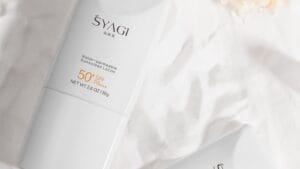
Quick answer: In a typical morning routine, sunscreen goes after your other skincare and before makeup. A simple order is cleanser → treatment if you already use one → moisturiser if needed → sunscreen → makeup. Choose a broad-spectrum or UVA/UVB sunscreen with SPF 30 or higher, apply enough to exposed skin, and reapply during outdoor exposure according to the label.
This guide focuses on the routine decisions that actually matter: order, amount, timing, reapplication, moisturiser, makeup and what to do when sunscreen feels too heavy. You do not need a complicated morning routine to use SPF correctly.
The Sunscreen Rules That Matter in a Morning Routine
- Put sunscreen after your other skincare.
- Use SPF 30 or higher with strong UVA/UVB protection.
- Apply enough to cover exposed skin evenly.
- Apply before outdoor exposure.
- Reapply when you remain outdoors and after swimming or sweating.
- Do not mix sunscreen into moisturiser or foundation to save a step.
- Keep the rest of the routine as simple as your skin allows.
The American Academy of Dermatology places sunscreen after treatment and moisturiser and before makeup. It also recommends broad-spectrum, water-resistant sunscreen with SPF 30 or higher for outdoor sun protection.
Sunscreen Goes After Your Other Skincare
A practical morning order is:
- Cleanse if needed.
- Apply a treatment or serum only if it is already part of your routine.
- Use moisturiser if your skin needs it.
- Apply sunscreen.
- Apply makeup after the sunscreen has settled, if you wear makeup.
You do not need toner, essence and several serums before sunscreen just because those products exist. If you are still building your basics, use our best skincare routine in Kenya guide.
Choose SPF 30 or Higher and UVA/UVB Protection
SPF is only one part of sunscreen selection. The AAD recommends a sunscreen that is SPF 30 or higher, broad spectrum and water resistant. Broad spectrum means the product is designed to protect against both UVA and UVB.
Many Asian sunscreens use a PA rating to communicate UVA protection. Whatever labelling system you see, do not shop by SPF number alone. Strong UVA protection, a suitable finish and correct application all matter.
If you want the broader buying framework, read our sunscreen Kenya guide.
Use Enough Sunscreen
Under-application is one of the easiest ways to get less protection than the product label suggests. Current AAD guidance says most adults need about one ounce to cover all exposed body skin. For the face, the AAD currently advises at least one teaspoon, described as approximately the amount needed to cover the length of the index and middle fingers.
Follow the exact directions on your product as well. Apply an even layer to the areas that will be exposed, including commonly missed areas such as the ears and neck when they are not covered.
A high SPF number is not permission to apply a tiny amount. The labelled protection depends on using the product correctly.
Apply Sunscreen Before Outdoor Exposure
The AAD advises applying sunscreen to dry skin about 15 minutes before going outdoors. This is useful when planning a morning routine: do not wait until you are already in direct sun to begin applying.
You also do not need to create a long waiting period between every skincare layer. Let each step settle enough that you can spread the next product without excessive pilling or rubbing, then complete the routine in a way you can repeat consistently.
Reapply During Outdoor Exposure
When you remain outdoors, AAD guidance recommends reapplying sunscreen approximately every two hours and after swimming or sweating, following the product directions.
Water resistance is product-specific. Some sunscreen labels state 40 or 80 minutes of water resistance. Do not call a sunscreen waterproof or assume every SPF50 formula is water resistant.
Your real reapplication need depends on exposure. A day spent mainly indoors is different from a beach day, outdoor work, sports, a long walk or hours of commuting and errands. Use your actual day rather than a rigid social-media schedule.
Do Not Mix Sunscreen With Moisturiser or Foundation
Apply sunscreen as its own even layer. Mixing it into moisturiser, facial oil or foundation can make it harder to know whether you have applied the sunscreen evenly and in the intended amount.
If you want fewer steps, a moisturiser that is itself labelled as a broad-spectrum SPF 30+ product can be used according to its sunscreen directions. The important point is to treat the SPF product like sunscreen — not like a tiny dab of cosmetic moisturiser.
Keep the Routine Simple Enough to Repeat
More skincare before sunscreen is not automatically better. If your morning routine pills, feels too heavy or takes so long that you skip sunscreen, simplify it.
A strong beginner routine can be:
- Cleanser: only as much cleansing as your skin and morning need.
- Moisturiser: if needed for comfort.
- Sunscreen: the final skincare step.
Add one targeted treatment only when you have a clear reason and your skin is tolerating the basics.
Do You Need Moisturiser Under Sunscreen?
Not always. If your sunscreen is moisturising enough and your skin feels comfortable, you may not need a separate moisturiser underneath. If your skin feels dry or tight without one, keep a moisturiser that already works for you.
For oily skin, the answer is still based on comfort rather than a blanket rule. You may prefer a lighter moisturiser, less moisturiser in oilier areas, or no separate moisturiser when the sunscreen already gives enough comfort.
If your skin is already irritated or unusually stingy, solve that problem before adding more morning layers. Our skin barrier repair guide explains when simplifying is the better move.
Can You Put Makeup Over Sunscreen?
Yes. The AAD places makeup after moisturiser and/or sunscreen in the skincare order. Apply your sunscreen evenly, allow it to settle, then apply makeup with as little unnecessary rubbing as practical.
If makeup consistently makes your sunscreen pill or move, test the combination rather than assuming either product is universally “bad.” Texture compatibility can vary between formulas.
What if Sunscreen Makes Your Face Greasy?
Do not compensate by applying less sunscreen than the product directions require. Instead, review the layers underneath and the sunscreen finish itself.
You may find that a lighter moisturiser, skipping an unnecessary serum, or choosing a sunscreen positioned as non-greasy or semi-matte makes the routine easier to wear. Our oily-skin sunscreen comparison covers that decision in more detail.
What if Sunscreen Leaves a White Cast?
White cast can make a product harder to wear consistently, especially on deeper skin tones. Manufacturer terms such as “sheer,” “invisible” or “zero white cast” can help you shortlist formulas, but individual results can vary with skin tone, application amount and what is layered underneath.
If possible, test the sunscreen using the amount you would realistically wear rather than judging from a small swatch.
Does Higher SPF Mean Fewer Reapplications?
No. The AAD notes that higher SPF numbers do not mean you can spend longer outdoors without reapplication. SPF30 blocks about 97% of UVB under test conditions, and higher SPFs block somewhat more, but no sunscreen blocks 100% of UVB.
Reapplication and other sun-protection measures still matter. Sunscreen should not be used as permission to extend sun exposure.
Should You Use Sunscreen on Cloudy Days?
If you will be outdoors, cloud cover is not a reliable reason to skip sun protection. AAD guidance notes that UV exposure can still occur on cloudy days.
Temperature is also not the same as UV risk. A cool morning can still involve meaningful ultraviolet exposure. Use current UV information and your actual exposure rather than how hot the weather feels.
When to Use Tinted Sunscreen
If dark spots or melasma are a major concern, tinted sunscreen containing iron oxide can be useful because visible light can contribute to pigmentation, particularly in darker skin tones. The AAD specifically recommends tinted sunscreen with iron oxide as part of dark-spot protection.
For the full pigmentation routine, see our hyperpigmentation skincare Kenya guide.
Sunscreen-in-Routine FAQs
Should sunscreen go before or after moisturiser?
For a typical morning skincare routine, apply sunscreen after moisturiser and before makeup.
Can I skip moisturiser and use only sunscreen?
Yes, if your sunscreen leaves your skin comfortable and provides the protection you need. A separate moisturiser is not mandatory when it solves no additional problem.
How long before going outside should I apply sunscreen?
AAD guidance says to apply sunscreen about 15 minutes before going outdoors.
How often should I reapply sunscreen?
When outdoors, reapply approximately every two hours and after swimming or sweating, following the directions on the bottle.
Can I mix sunscreen into foundation?
It is better to apply sunscreen as its own even layer, then apply foundation afterward.
Do I need SPF50 every day?
Not universally. SPF30 or higher is the dermatology baseline. SPF50 or SPF50+ is a valid higher-protection choice, but the higher number does not replace correct application or reapplication.
Where can I compare current Simpli sunscreens?
Use the Sun Protection collection for the current published range rather than relying on old product lists inside evergreen articles.
Final Takeaway
Where sunscreen fits in your morning routine is simple: finish the skincare steps you actually need, apply sunscreen evenly as the final skincare layer, then add makeup if you wear it. Use SPF30 or higher with strong UVA/UVB protection, apply enough, and reapply during outdoor exposure.
If the routine becomes too heavy or complicated, remove unnecessary steps before you reduce the sunscreen itself. Choose less. Choose better. Know why.