
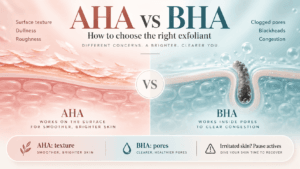
Quick answer: if your main problem is rough, dull-looking surface texture, an AHA may be the more relevant exfoliant to investigate. If your main problem is clogged pores, blackheads or oily congestion, a BHA — in everyday skincare, usually salicylic acid — may make more sense. If your skin is already stinging, peeling, sunburned, unusually tight or suddenly reactive, the better answer may be neither for now.
The useful question is not, “Which acid is stronger?” It is: where is the problem, how calm is your skin, and what is already in your routine?
That sounds less exciting than buying the most famous acid on TikTok. It is also far more useful.
AHA vs BHA: the simplest way to choose
Think of the decision in three lanes:
- Choose AHA first when the job is mainly surface-level: rough feel, dull-looking texture or uneven-looking surface tone.
- Choose BHA first when the job is mainly pore-focused: blackheads, clogged-looking pores, oilier congestion or a tendency to feel “blocked” rather than simply rough.
- Choose neither for now when your skin is already irritated, peeling, burning, sunburned or struggling with several strong actives at once.
That is the decision framework for most beginners. Everything else — acid percentage, format, frequency and product choice — comes after it.
What is an AHA?
AHA means alpha hydroxy acid. Glycolic acid and lactic acid are among the most common AHAs used in cosmetic skincare.
AHAs are used to exfoliate the skin surface. The US Food and Drug Administration notes that the effect of an AHA product depends on more than the ingredient name alone. Concentration matters, but so do factors such as the finished product’s pH and formulation.
This is important because skincare shopping often reduces acids to a percentage competition. A “7% glycolic” label does not tell you everything about how the finished product will behave on your skin. A rinse-off cleanser, a leave-on toner and a professional-strength peel are not interchangeable just because the same acid appears on the label.
Practical translation: if your concern is mainly how the skin surface feels or looks — roughness, dullness or uneven-looking texture — AHA is usually the more logical category to investigate first.
What is a BHA?
BHA means beta hydroxy acid. In everyday cosmetic skincare, the BHA shoppers most commonly encounter is salicylic acid.
Salicylic acid is commonly used in products aimed at clogged pores and oily or congestion-prone skin. The American Academy of Dermatology also notes that salicylic acid can help unclog pores.
That does not mean everyone with oily skin automatically needs BHA, or that someone with dry skin can never use it. Skin-type labels are useful, but they are not enough on their own. The better question is what you are trying to change and whether the exact product fits your current routine.
The mistake: choosing by skin type alone
“Dry skin = AHA. Oily skin = BHA.” You will see that rule everywhere because it is easy to remember. It is also too blunt to make every decision for you.
You can have oily skin and still be dealing mainly with rough surface texture. You can have dry skin and still have a congested nose or chin. You can have combination skin, post-acne marks and a perfectly adequate routine that does not need another exfoliant at all.
So start with the problem you can actually describe, not the skin-type label you were given years ago.
If your main problem is rough or dull-looking texture
An AHA may make sense. You are trying to improve a surface-level concern, so a surface exfoliant is a reasonable category to consider.
But do not turn that into “stronger AHA = faster glow”. The exact formula matters, and more irritation is not proof of better exfoliation.
If your main problem is blackheads or clogged-looking pores
A salicylic-acid BHA may be the more relevant first option.
Before buying one, check your existing routine. If your cleanser already contains salicylic acid and you also use an exfoliating toner, adding another leave-on BHA may simply duplicate the same job.
Buying three products for one problem is an expensive way to make it harder to know what is actually working.
If you have both texture and congestion
You do not have to solve both at once.
Choose the concern that matters most, introduce one exfoliating product, observe how your skin responds and reassess. One controlled change gives you information. Four new actives give you guesswork.
If your skin is already irritated
Choose neither for now.
If water stings, your usual moisturiser suddenly burns, your face feels persistently tight, you are visibly peeling or products that were previously comfortable are suddenly uncomfortable, another exfoliating acid is unlikely to simplify the situation.
The American Academy of Dermatology warns that exfoliation is not right for everyone and that overdoing it can leave skin red and irritated. Return to a simpler routine first. Our skin barrier guide can help you decide what to pause while your skin settles.
What if dark marks are your main concern?
This is where the AHA-vs-BHA conversation often becomes too simplistic.
Dark marks can have different causes, and an exfoliant is not automatically the first or only answer. If your marks tend to follow breakouts, irritation or picking, preventing new inflammation and protecting your skin from further irritation may matter just as much as choosing an acid.
This is particularly important for people who tend to develop noticeable pigmentation after irritation. The AAD cautions that more aggressive exfoliation can contribute to increased pigmentation in some people, especially those with darker skin tones or a history of dark marks after irritation or injury.
So if your goal is “fade dark marks”, do not translate that into “buy the strongest exfoliating acid”. First ask what keeps creating the marks.
Why higher percentages are not automatically better
Acids invite a kind of skincare mathematics that looks scientific but often is not: 5% must be better than 3%, 10% must be better than 5%, and if it tingles more it must be working harder.
That logic ignores the finished formula.
With AHAs, the FDA specifically notes that concentration and pH both affect how a product behaves. Vehicle, exposure time, how often you use it and what else is in your routine also matter to the experience of the finished product.
The useful question is not, “What is the biggest number I can tolerate?” It is, “What is the least aggressive product that solves the problem without creating a new one?”
Can you use AHA and BHA together?
Yes, some finished products are deliberately formulated with both. That does not mean you need to layer two separate exfoliants in the same routine.
If you are new to acids, using one at a time is easier to evaluate. You can see whether it helps, how your skin tolerates it and whether a second exfoliant is even necessary.
Layering AHA, BHA, a scrub and a retinoid because each one has a different job may sound efficient on paper. On skin, the total irritation load still counts.
What about retinol, retinoids and benzoyl peroxide?
Be cautious about piling exfoliation on top of products that already make your skin dry, sensitive or prone to peeling.
The AAD specifically advises people to consider products such as prescription retinoids, retinol and benzoyl peroxide before exfoliating because the combination may worsen dryness or irritation.
This does not mean those ingredients can never exist in the same broader routine. It means you should not assume that adding another active is harmless just because each ingredient is popular on its own.
When in doubt, simplify the experiment: one new active, one clear job, enough time to observe.
How to introduce an exfoliating acid without overdoing it
Simpli’s Start-Safe approach is deliberately boring in the best way: change less, learn more.
- Stabilise first. If your skin is already irritated, wait.
- Name one problem. Roughness? Congestion? Do not ask one new product to fix your entire face.
- Choose one exfoliant. AHA or BHA. Not AHA plus BHA plus scrub on day one.
- Follow the exact product directions. Do not copy someone else’s schedule when you are not using the same formula.
- If the label gives a frequency range, start at the less frequent end.
- Keep the rest of the routine simple. Gentle cleansing, moisturiser when needed, sunscreen in the morning.
- Observe. Persistent burning, prolonged stinging, peeling or escalating sensitivity are not milestones.
- Adjust only after you have learned something.
The FDA also advises testing BHA-containing cosmetics on a small area before wider use, following label directions and stopping if irritation or prolonged stinging develops.
How often should you use AHA or BHA?
There is no responsible universal answer such as “three nights a week” for every acid product.
Frequency depends on the exact formula, concentration, format, your skin and the rest of your routine. The AAD’s useful general rule is that the more aggressive the exfoliation method, the less often it usually needs to be done.
That is why the product directions matter more than somebody else’s acid calendar.
Sun protection is part of the acid decision
If you are using an AHA, sun protection belongs in the same conversation.
The FDA warns that AHA-containing cosmetics may increase skin sensitivity to the sun and the possibility of sunburn. Its recommended precautions include sunscreen, protective clothing and limiting sun exposure while using the product and for a period after stopping it.
FDA guidance for BHA-containing cosmetics also advises sun protection.
If sunscreen is still the confusing part of your routine, start with our guide to where sunscreen fits in your morning routine.
Signs you may be over-exfoliating
Over-exfoliation does not always arrive as one dramatic reaction. Sometimes it looks like a routine slowly becoming harder to live with.
- persistent redness or irritation;
- burning or stinging that does not settle;
- new tightness after washing;
- flaking or peeling;
- skin reacting to products it previously tolerated;
- dark marks appearing after irritation;
- adding more “soothing” products while the routine keeps getting less comfortable.
If that sounds familiar, stop trying to exfoliate your way out of the problem. Reduce the irritation load and let comfort become the goal again.
Do you actually need an exfoliant?
Possibly not.
A complete skincare routine does not have to contain AHA or BHA. If your skin is comfortable, your current routine is doing its job and you cannot identify a specific texture or congestion problem that exfoliation is meant to solve, you may not be missing anything.
An exfoliant should earn its place.
If the only reason you want one is that everyone online seems to have an “acid night”, keeping your routine as it is may be the smarter decision.
AHA vs BHA FAQs
Is AHA or BHA better for beginners?
Neither category is automatically better for beginners. Choose based on the problem you are solving, then introduce one suitable finished product according to its directions.
Is salicylic acid the same as BHA?
In everyday cosmetic skincare, “BHA” usually refers to salicylic acid because the FDA identifies salicylic acid as the BHA most commonly used in cosmetics.
Is glycolic acid an AHA?
Yes. Glycolic acid is one of the most common AHAs used in cosmetic skincare. Lactic acid is another common example.
Can I use AHA and BHA on the same day?
Some finished products are formulated with both, but layering separate AHA and BHA products is not automatically necessary. If you are still learning your tolerance, one exfoliant at a time is easier to evaluate.
Which is better for blackheads: AHA or BHA?
For blackheads and clogged-looking pores, salicylic-acid BHA is usually the more relevant category to investigate because it is commonly used for pore congestion.
Which is better for rough texture: AHA or BHA?
If the concern is mainly rough, dull-looking surface texture, AHA is often the more relevant first category to consider.
Can I use acids if I get dark marks easily?
Use extra caution with aggressive exfoliation. The AAD notes that some people, particularly those with darker skin tones or a tendency to develop dark spots after irritation, can develop increased pigmentation after more aggressive exfoliation.
What should I do if my face burns after exfoliating?
Stop the exfoliating product and other irritating actives, keep the routine gentle and monitor your skin. Severe, painful, persistent or worsening reactions deserve assessment from a qualified medical professional rather than another skincare experiment.
The Simpli takeaway
AHA vs BHA is not a contest.
AHA is the more logical first direction when the job is mainly surface texture. BHA is the more logical first direction when the job is mainly clogged pores and oily congestion. And if your skin is already irritated, neither may be the smartest answer today.
The goal is not to use more acids. It is to solve one clear problem with the least unnecessary irritation.
Choose less. Choose better. Know why.